Tuesday, June 21, 2016

Bulgaria Day Six

On Monday June 13th with breakfast only available at 8:00 we decided to get up and watch birds for an hour before starting the day proper. Having set an early alarm clock we found ourselves up and about in the rain. We did not go far from the car and soon arrived back at the hotel. But in our short time out we saw plenty of Common and Sandwich Terns, a few waders (Pied Avocet, Black-winged Stilt, Green Sandpiper, Greenshank), a pair of Garganey and my lifer Pygmy Cormorant.

Pygmy Cormorant and Grey Heron
Sandwich Terns

The rain cleared up over breakfast and we returned to the same spot around 9:00 and spent the morning in the salt pans around Pomorie adding many more species of wader and herons to our list, and I saw both Great White and Dalmatian Pelicans - two of my high trip targets - while there. A group of 5 Little Gulls arrived as we were abut to leave and we watched them fuss about the shallow water taking insects from the top. Great Reed, Reed and Cetti's warblers made a lot of noise in the reed beds.

Spoonbill
Great White and Dalmation Pelicans

We then headed inland and stopped off at a field to see Collared Pratincoles flying above their nests before hiking to an estuary area where we saw 116 Ruddy Shelduck - a high number for Daniel - and my some Gull-billed Terns.But the highlight of this spot was the best mammal of the trip - a Jackal. We heard some rustling in the bushes nearby, Daniel clapped hands twice and it ran like the clappers to the far side of the field!


We then drove to a lake where Daniel knew White-tailed Eagles were nesting and we saw one bird perched in the trees. We also had about 30 Black Terns skimming the surface like swallows and a closer view of a pelican.

Dalmatian Pelican

Monday, June 20, 2016

Bulgaria Day Five

Sunday June 12th was our transition day starting in the mountains and ending on the Black Sea coast. In between we birded around Svivelengrad where we were within 2km of Greece and 5km of Turkey.

In the morning we drove through places we had birded seriously over the past couple of days stopping only to look at raptors overhead - we had all three Buzzards, Common, Eurasian Honey and Long-legged - and when Daniel heard and then attracted a Middle Spotted Woodpecker into view. We had seen many Corn Buntings and Red-backed Shrikes over the past days, but unbeknown to me at that time these two species continued to be seen regularly for the remainder of the trip.

Corn Bunting
Red-backed Shrike


We took a slight detour at a point near the Greek and Turkish borders to have lunch and to wait at Daniel's special spot for Levant Sparrowhawk. We had a brief sighting of the male bird but did not cooperate as Daniel had hoped. We saw our only Black Kite of the trip while scanning the sky at this lunchtime stop. Returning to our route we pulled off the main road and waited just a few minutes before a cooperative Imperial Eagle flew over.

A highlight of the trip was to see a conservation project for Lesser Kestrels. These birds had been introduced a year earlier, had flown to Africa for the winter and had now returned to breed.  Lesser Kestrels are communal and the facility had a number of nest holes for them in two different buildings. Eggs were monitored and fledglings gathered into one place - we saw a group of nearly 30 through the TV monitors. A number of birds were flying around looking for insects and I enjoyed ading this bird to my life list.

Plastic Lesser Kestrel
Artificial Nest Holes
Captive adults used in rearing the chicks

This was a long driving day and as we got to the edge of the city of Burgas I had another lifer. A Lesser Spotted Eagle perched in a tree along the main road and gave us long views through the scope. We ended the day on the other side of Burgas, in Pomorie, a Black Sea resort with a strong Russian presence.

Bulgaria Day Four

Saturday June 11th was our last full day in the mountains and we focused on getting the species that had eluded us so far. We returned to the Rock Nuthatch spot hoping we might run into this species although the nest was no longer in use. Alas we did not find this bird. Instead though we saw a falcon flying along the ridge, then two, three, four, five! A family of Eleonora's Falcons were hawking insects above the skyline. This was an unexpected species, a lifer for me and the first time Daniel had seen a family group acting in this way. We also saw a couple of Chukar Partridge on the ridge.

We then moved on to look for Masked Shrike and had no luck until Daniel saw a long tailed bird fly from the wire when we had almost given up. Daniel then located a nest and I was able to watch the 2 adults feed 4 young in the nest through a scope for about half an hour. We had moved into a slightly different habitat and had our first Hoopoes, Bee Eaters, Rollers and Golden Orioles of the trip. We also saw a Honey Buzzard in the forest and followed the bird along as it flew through the trees but the bird did not emerge for an overhead view.

We also saw many Fallow Deer along the woodland edges and a Land Tortoise on the road. We were close to an area where European Bison had been introduced but saw only the electric fence to keep them in and not the animals themselves.

Fallow Deer

Hoopoe

Land Tortoise
After sunset we headed to a local park where European Scops Owls were calling. We heard at least two birds and replied to Daniel's taped calls. These birds gave us the run around for quite a while!

Bulgaria Day Three

We spent the whole day of Friday June 10th around Krumovgrad, but it was another long day. We left immediately after out 8:00am breakfast and got back just in time for an 8:30pm dinner.

The main goal of the day was to head out to the vulture 'restaurant', a spot where butcher scraps and sometimes carcasses are laid to attract the vultures. The site has a cage into which birds may be attracted so that rings and radio trackers may be attached to birds.

Along the way we saw many White Storks in the villages. The utility company puts nest bases on top of some of the poles to stop the birds building on the power lines where problems may arise. The storks are welcomed by the locals who consider the birds as bringers of good luck.

White Storks
Sparrows breed in the lower parts of the Stork nest, afforded some protection by the storks. Often there was a mix of House Sparrows, Tree Sparrows and Spanish Sparrows. The latter was a life bird for me.

Tree Sparrow

As we left the villagers and headed to higher ground we saw many shrikes - Red-backed, Lesser Gray and Woodchat as well as Crested, Wood and Sky Larks, and a couple of Short-toed Eagles. We stopped at a few spots along the way when Daniel heard warblers singing and added Sardinian, Subalpine and my lifer Barred Warbler to the trip list.

Crested Lark
Woodchat Shrike

Nearing the vulture restaurant we ran into two local biologists who had just left butcher scraps near the cage and we hiked up to a viewing spot with Anton to see what happened. By the time we had walked 15 minutes to the spot there were many Eurasian Griffon Vultures in the air, soon joined by a rare Cinereous (or European Black) Vulture and some Egyptian Vultures. The birds circles for a while and some sat on the nearby cliffs but only Common Ravens and Hooded Crows came down to eat in the two hours we were there. We also saw a Golden Eagle and a couple of Common Buzzards while watching the skies at this spot.

We then drove down along a new route and Daniel heard a Lesser Spotted Woodpecker. We followed this to a remarkable tree in which I then had 3 lifers in 15 minutes! First a Syrian Woodpecker, then a Hawinch and finally a couple of Sombre Tits! We also saw our first Red-rumped Swallows of the trip

Red-rumped Swallows

We then drove quite a way to the day's final location spotting two Black Storks and a Long-legged Buzzard along the way. But the Eastern Rock Nuthatch chicks had fledged and these birds were no longer at Daniel's location for them. We had to settle for Ortolan and Rock Buntings, a Black-eared Wheatear and (after some searching) a Blue Rock Thrush.

Long-legged Buzzard

Resting after dinner at the end of the day I could hear a Eurasian Scops Owl calling from close to the hotel.

Bulgaria Day Two

After breakfast on Thursday June 9th we spent some time scanning swifts and with the help of Daniel's camera were able to confirm that Pallid Swifts made up at least some of the birds flying about. Crag Martins were the most common of the overhead fliers.

We then went to a famous spot in Trigad Gorge where a Wallcreeper had given close views, until it disappeared about a month earlier! Nevertheless we spent three hours in the gorge at prime spots looking for the bird without luck. We did see three White-throated Dippers, two Serins and a number of Grey Wagtails and Alpine Swifts.

White-throated Dipper

We had lunch at a restaurant further down the gorge before turning back and heading to Krumovgrad. On the way we stopped at one of Daniel's known spots to play tape and had a Black Woodpecker immediately respond giving us close views. Later we made some stops in some farm areas and found things like Black Redstarts and Mistle Thrushes before one stop gave me two lifers - Eastern Olivaceous Warbler and Black-headed Bunting. We then headed to our hotel on the town square after a second long day in a row.

Eastern Olivaceous Warbler
Black-headed Bunting

Bulgaria - Day One

I flew from Stansted to Sofia on Tuesday June 7th arriving in the evening. Petar met me and took me to the nearby Ibis Hotel. I had breakfast at 6:30 and Daniel arrived at 7:00 for a long first day of the trip, Wednesday 8th,

The weather was not good and we traveled through the rain to the area around Belmeken. Our first good bird was a Eurasian Nutracker as we traveled up to Belmeken Reservoir at 2000 metres above sea level. We then hiked over 10 miles with an elevation change of 500 meters in 40F (5C) to get the days target bird Alpine Accentor. The hike was a good one with lots of mountain specialist sepcies such as Ring Ousel, Tree Pipit, Black Redstart, Whinchat, Water Pipit and breeding Horned Larks to keep us interested. We also saw a European Hare and heard Susliks, communal European ground squirrels calling from the long grass near their burrows. Daniel's tape finally interested our target and I had four different close views of the target bird. On the descent back to the car I had an Adder cross the trail in front of me.

Tree Pipit
Whinchat
We then headed down the mountain past a ski resort stopping to hear Corncrakes calling from long grass along the way ending the day with a drive through the beautiful Trigad Gorge to spend the night at a nice family owned hotel.
Tuesday, June 7, 2016

England - short stop

I arrived at Heathrow at noon on Sunday June 5th on a 2-day stop en route to Bulgaria. I did not have time to go out with my binoculars but managed 15 species from the house and trains including two species I would not find in Bulgaria - Lesser Black-backed Gull and Carrion Crow.

Yosemite National Park

My wife and I made a short visit to Yosemite arriving at lunchtime on Tuesday 24th and leaving 48 hours later on Thursday 26th. We stopped along the creek soon after going through the entrance station and immediately found an American Dipper. It turned out that this was the only dipper we saw on the trip despite spending much time along the waterways. In part, I'm sure, was the fact that Yosemite was jam packed with people with the valley crowded everywhere we went.

On Wednesday May 25th we walked out to a swing bridge in an area, Wawona, away from the valley. This proved to be the hoped-for peaceful hike and we found both White-headed and Pileated Woodpeckers and my FOY Hermit Warbler.

White-headed Woodpecker

After spending the middle part of the day in the crowded valley doing expected things - short hikes and visiting waterfalls - we ended the day with a drive to Glacier Point for the lovely view of the valley and the surrounding area. Birds at this highest elevation included Red-breasted Nuthatch.

In the morning of Wednesday 26th we stopped at another area in Wawona for a short hike near the golf course where Hutton's Vireo was the highlight. On our way out of the park on the west side we stopped to walk down to a grove of Sequoias and found a Pacific Wren while we were by these giant trees.

Pacific Wren

San Jose and Milpitas

My wife and I had spent one day in San Jose looking for accommodation on April 30th and ran into both Nuttall's Woodpecker and California Towhee while doing so. We even had a Vaux's Swift at the airport when I arrived after work on Friday 29th.


We visited a new part of the San Francisco Bay NWR, in Milpitas on Saturday May 21st. We had chosen this part of the bay because of mentions of a Barn Owl next box, and found this and a bird inside quickly on the reserve. Our walk around one of the bay trails was a noisy one with Black-necked Stilts reacting to our presence and Song Sparrows singing everywhere.We ran into a flock of Bushtits as we returned to the car park.

Song Sparrow

American White Pelican

Black-necked Stilt

Barn Owl
Later that day we drove up to Livermore and stopped Shadow Cliffs Regional Park where the most interesting bird was a Canada x Greater White-fronted Goose:
Canada x Greater White-fronted Goose
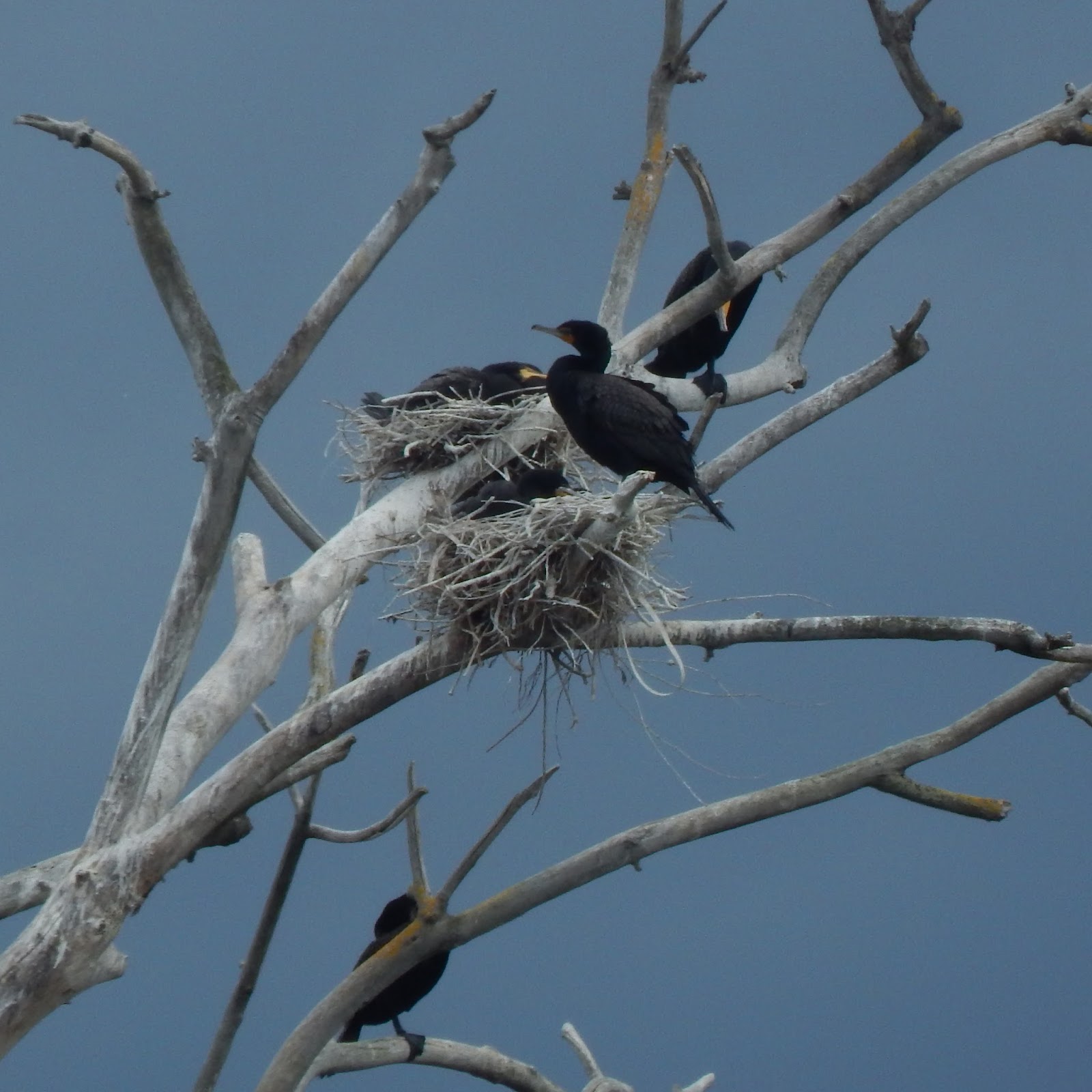
The park also hosted a breeding colony of Double-crested Cormorants

Double-crested Cormorants
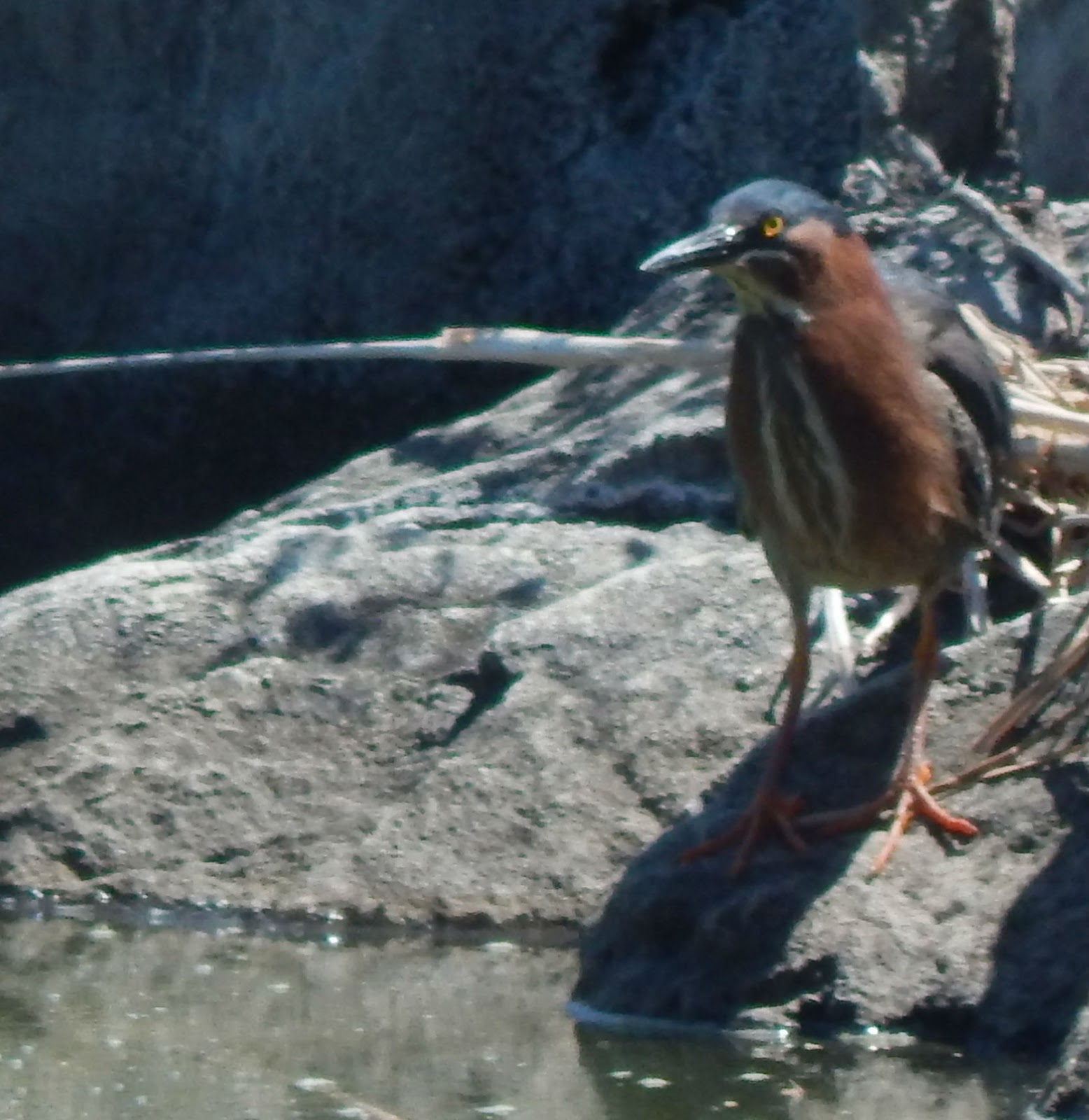
On Tuesday May 31st I walked around Lake Cunningham hoping to add a couple of more species before leaving for Europe. I had a pair of Chestnut-backed Chickadees soon after I left the car and a Purple Finch in the trees most ways around the loop. Then having given up hope of seeing one a Green Heron flew in from across the lake and landed close by.

Green Heron

Santa Teresa County Park

On Sunday May 22nd my wife and I made our first visit to Santa Teresa County park, just down the road from the rental house. This appears to be a nice 'local haunt' for us, and on our short hike we heard California Quail and saw both Oak Titmouse and Band-tailed Pigeon. We ended our hike by taking a path from the Ohlone Trail to the car park of the golf course and had an Ash-throated Flycatcher as we got there. The golf course held expected species such as Brewer's Blackbird, Canada Goose, Western Bluebird and Black Phoebe.

Moss Landing and Salinas River

On May 18th my wife and I went down to our favorite haunt on the coast, Moss Landing. Our first stop was at the old salt ponds, now named the Moss Landing State Wildlife Area, where much of what we saw was as expected - Harbour Seals, Sea Otters and birds along the shoreline including my FOY Savannah Sparrow. An area had been fenced off for breeding Snowy Plovers and we could see a couple in the distance.

Savannah Sparrow
We then crossed the busy highway and took Jetty Road to park and do a loop of the beach and the mudflats. As ever birds were abundant and we had Bonaparte's Gulls, Elegant Terns and at least one Pelagic Cormorant. Unusual sightings were Common Loons and Surf Scoter sitting on the mud.
 
Common Loon
Surf Scoter
Pacific Loon
Ten days later, on May 28th we went back to the coast but this time went to the Salinas River NWR. This was not the easiest place to get to, and would have been impossible in wetter conditions as the last part of the road was simply dirt. But the walk down to the beach was nice and I added Caspian Tern, Dunlin and Semipalmated Plover for the year. On the way back we saw a Western Wood-Pewee flycatching from the bushes.

Savannah Sparrow

Western Wood-Pewee